Maritime Case Study: When Routine Outran Reality — The MV Hoegh Osaka Listing and Grounding (2015)

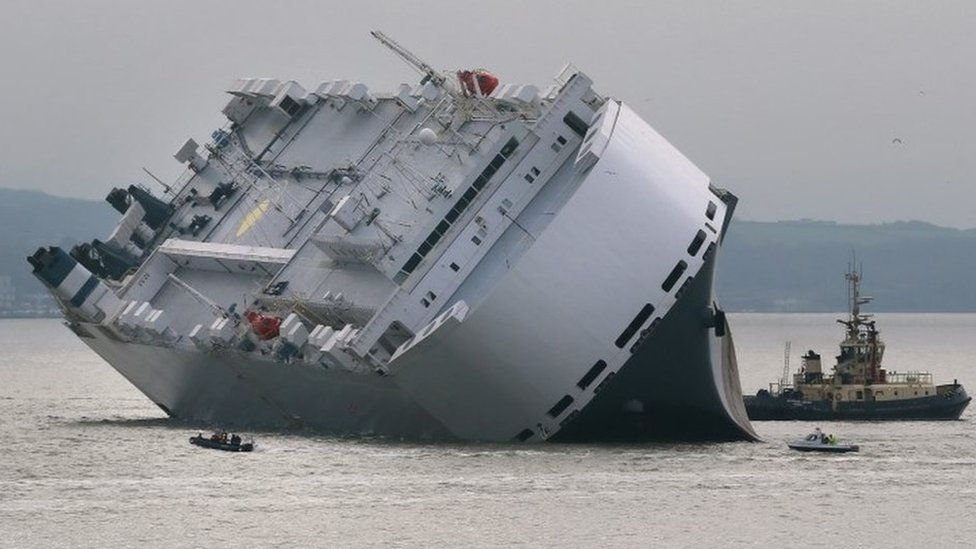
On January 3rd, 2015, the Pure Car and Truck Carrier MV Hoegh Osaka left Southampton bound for Bremerhaven.Within 25 minutes, she developed a violent list to starboard.
With the ship rolling past 40 degrees and cargo breaking free, the Master made a critical decision: he steered the vessel toward Bramble Bank and intentionally grounded her to prevent capsize.It was a move that likely saved every life on board.
But the incident was never about bad luck — it was about the quiet erosion of safety discipline.
What the Investigation Found
The MAIB concluded that the vessel sailed with insufficient stability — the centre of gravity sat dangerously high above the ship’s metacentric height.
Why? Because the final stability calculation wasn’t done.The Chief Officer had relied on estimated cargo weights and outdated ballast data, assuming they were “close enough.”High-density cargo, stowed higher than normal due to a last-minute change in the loading plan, pushed the ship past the edge of safe stability.
When the vessel heeled, every missed calculation and unchecked assumption suddenly became visible.
ICAM Lens: How Defences Failed
Absent / Failed Defences:The final pre-departure stability check — the last line of technical defence — was never properly completed using verified cargo and ballast figures.
Individual / Team Actions:The Chief Officer, under time pressure, accepted estimated data and sailed without confirming the true stability condition.
Task / Environmental Conditions:A non-standard loading plan placed heavier vehicles higher in the decks, dramatically raising the ship’s centre of gravity and reducing GM.
Organisational Factors:The company’s Safety Management System had allowed informal practices to become the norm. Over time, speed and convenience replaced rigour and verification. The procedures still existed — they just lived on paper.
The Leadership Lesson
The Hoegh Osaka incident is a classic case of systemic drift — the slow normalization of shortcuts until the system itself becomes unsafe.The paperwork was perfect; the practice was not.
When safety systems degrade into routine box-ticking, the only true defence left is leadership accountability — leaders who verify the fundamentals, who treat compliance as a living discipline, not an administrative exercise.
As the MAIB wrote, “The ship did not capsize by chance.”That line should haunt every leader who manages risk in complex systems.
Question for Leaders:Where in your operation have “routine assumptions” replaced verified facts?


Comments